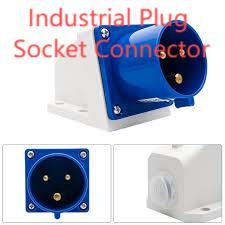
Choosing the correct Industrial Plug Socket Connector at the start of a project reduces downtime and improves safety, because the right interface ensures consistent contact, easy maintenance, and predictable performance under load. In many installations, engineers now require the Industrial Plug Socket Connector to meet specific mechanical, thermal, and ingress-protection standards so that equipment remains serviceable and safe in harsh factory, outdoor, or mobile environments.
1. Core Electrical and Mechanical Requirements
Industrial connectors must carry rated voltages and currents while resisting vibration, shock, and repeated mating cycles. Key specifications include contact resistance, dielectric strength, and rated current under continuous load. Mechanically, housings should resist impact and maintain alignment so pins and sockets mate cleanly every time. Designers also consider retention methods, locking levers, and keying to prevent mismatches. When specifying parts, compare datasheet values for endurance cycles, IP/IK ratings, and ambient temperature ranges to ensure long-term reliability.
2. Contact Materials and Corrosion Resistance
Contacts are the heart of any connector. Common options include copper alloys plated with silver, nickel, or gold depending on conductivity and corrosion requirements. Plating choices influence contact resistance and lifespan, especially in high-cycle or corrosive environments. Insulation materials and seals determine how well the connector resists moisture and chemical exposure. For installations near salt spray, chemicals, or frequent washdowns, choose finishes and gaskets engineered to withstand those conditions without compromising electrical integrity.
3. Thermal Performance and Overcurrent Protection
Thermal management matters because elevated contact temperatures accelerate wear and can cause insulation degradation. Look for connectors rated for continuous current that match or exceed expected loads; consider derating at higher ambient temperatures. Designs that allow heat dissipation—via conductive mounting plates or ventilation in enclosures—help maintain lower operating temperatures. Combine connectors with appropriate fusing, thermal sensors, or protective devices to prevent damage from overloads or accidental short circuits.
4. NANTE Compliance and Compatibility Options
Products that follow recognized standards simplify certification and integration. Seek connectors with IEC, UL, or regional approvals as relevant to the installation. Modular options—interchangeable inserts, varied contact arrangements, and accessory kits—help standardize designs across product families and simplify inventory. Manufacturers that publish clear mechanical drawings, wiring diagrams, and compatible mounting templates reduce installation errors and speed commissioning. Verified spare-part listings and lifecycle support policies further protect long-term operations.
5. Environmental Sealing and Ingress Protection
Ingress protection ratings (IP) define resistance to dust and water; choose an IP level appropriate to the exposure risk. Gasketed mating faces, bayonet or screw locks, and sealed cable glands prevent contamination. For dusty or wet environments, ensure seals maintain integrity after repeated use by selecting durable elastomers and tested compression designs. For mobile or vibration-prone systems, mechanical locks and strain-relief features prevent cable movement that could compromise seals or contacts.
6. Installation Practices and Cable Management
Careful installation reduces failures. Use correct torque values on terminals to prevent loose connections that generate heat. Provide adequate bend radii and strain relief so cables don’t pull on terminals. Labeling and color-coding simplify future maintenance and reduce the risk of incorrect reconnections. When routing multiple connectors, maintain separation between power and signal runs to reduce electromagnetic interference and ease troubleshooting.
7. Maintenance, Testing, and Lifecycle Planning
Establish a maintenance schedule that includes visual inspection, checking terminal torques, and verifying seals. Periodic contact resistance testing can identify degrading connections before they fail. Keep common spares—replacement inserts, gaskets, and locking hardware—on hand to minimize downtime. For critical systems, plan redundancy into the design so single-point failures don’t halt operation. Lifecycle planning that factors replacement intervals, repair options, and supplier support reduces total cost of ownership.
Practical Selection Checklist
Before purchasing, confirm required voltage and current ratings, environmental exposure, mechanical mounting needs, available accessories, and applicable certifications. Request sample units for fit and function tests and verify spare-part availability and lead times. Consider modular families that allow different contact configurations while maintaining the same mounting footprint for streamlined spares management.
Conclusion
Well-specified industrial connectors improve uptime, safety, and serviceability in demanding environments. Prioritize contact materials, sealing, thermal performance, and verified certifications when selecting connectors for heavy-duty applications. Thoughtful installation and proactive maintenance further extend service life and protect equipment. For detailed technical information, installation guidelines, and product references, please visit: https://www.nante.com/news/industry-news/what-is-industrial-plug.html

 English
 Arabic
 French
 Spanish
 Portuguese
 Deutsch
 Turkish
 Italiano
 Russian
 Romaian
 Portuguese (Brazil)
 Greek
Greek