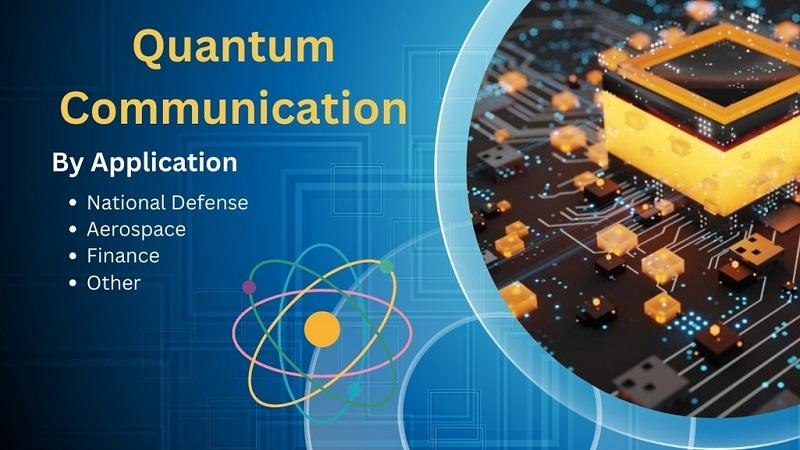
In an era defined by data and the constant threat of cyberattacks, Quantum Communication emerges as a revolutionary paradigm shift, promising a future of truly secure information exchange. Unlike classical communication, which relies on mathematical complexity for security, quantum communication is built upon the fundamental laws of physics. It leverages the bizarre yet predictable behaviors of subatomic particles, such as photons, to transmit data. The core principle underpinning its security is the "no-cloning theorem," which states that it is impossible to create an identical copy of an unknown quantum state. This means that any attempt by an eavesdropper to intercept and measure the quantum information will inevitably disturb it, leaving a detectable trace. This inherent "eavesdropper detection" mechanism makes quantum communication a fundamentally secure method for transmitting data, offering a solution to the growing threat posed by advanced computational and code-breaking capabilities.
The most prominent application of this technology today is Quantum Key Distribution (QKD). In a QKD system, two parties (conventionally named Alice and Bob) exchange a secret cryptographic key encoded in the quantum states of single photons. Alice sends a stream of photons with specific polarizations, and Bob measures them. Afterward, they communicate over a classical public channel to compare a subset of their measurement bases and results. This public discussion reveals any discrepancies that would have been caused by an eavesdropper (Eve) attempting to measure the photons mid-flight. If the error rate is low enough, they can distill a perfectly secure, shared secret key from the remaining data. This key can then be used to encrypt and decrypt sensitive information sent over a conventional network, ensuring its confidentiality with a level of security guaranteed by the laws of nature itself.
It is crucial to differentiate quantum communication from its more famous cousin, quantum computing. While both are branches of quantum information science, they serve different purposes. Quantum computing aims to harness quantum phenomena like superposition and entanglement to perform computations at speeds exponentially faster than classical computers, posing a future threat to current encryption standards. Quantum communication, on the other hand, is the defense against that very threat. It is not about faster computation but about secure transmission. Essentially, while quantum computers are being developed to break today's codes, quantum communication is being developed to create unbreakable ones, establishing a new foundation for secure data exchange in the quantum era.
The physical realization of quantum communication networks relies on a suite of highly specialized components. These include single-photon sources that can emit one photon at a time, highly sensitive single-photon detectors capable of registering the arrival of these faint light particles, and optical fibers or free-space links (including satellite communication) to transmit them. Looking to the future, the development of quantum repeaters and quantum memory is a critical area of research. These technologies will be essential for overcoming signal loss over long distances without disturbing the quantum state, paving the way for the creation of a truly global, ultra-secure "quantum internet" that will redefine secure communication for governments, industries, and individuals alike.
Explore More Like This in Our Regional Reports:
UK Artificial Intelligence Market

 English
 French
 Spanish
 Portuguese
 Deutsch
 Turkish
 Dutch
Dutch
 Italiano
 Russian
 Romaian
 Portuguese (Brazil)
 Greek
Greek