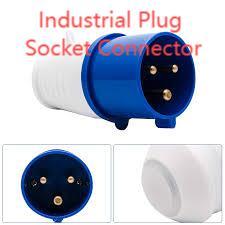
Engineers choose the Industrial Plug Socket Connector because it delivers secure, repeatable mating under harsh industrial stresses, and installers often value how the Industrial Plug Socket Connector speeds serviceability while protecting personnel and equipment. This article explains design trade-offs, standards to consider, installation tips, and maintenance strategies so specifiers and maintenance teams can select connectors that reduce downtime and improve safety across production, processing, and infrastructure sites.
Materials and Mechanical Durability
Connector housings and contacts must resist impact, corrosion, and mechanical wear. Common choices include nickel-plated copper alloys for contacts and glass-filled nylon or die-cast aluminum for bodies. Contact plating and spring design determine mating life and resistance to fretting corrosion. Sealing features — O-rings, molded gaskets, and pressure-equalizing vents — prevent ingress of dust and fluids while allowing normal pressure equilibration that avoids seal extrusion. Choose IK-rated faces and corrosion-grade fasteners where equipment faces regular mechanical abuse or washdown exposure.
Electrical Performance and Compliance
Match connectors to expected current, voltage, and duty cycles. Look for products with clear ampacity charts and derating curves for varying ambient temperatures. Make sure dielectric withstanding voltage, short-circuit withstand, and IP/IK ratings align with application requirements. For motor feeds and variable-speed drives, consider harmonic distortion and inrush currents when specifying conductor sizes and protective devices. Where regulatory oversight exists, prefer third-party listings and compliance statements to simplify approval and commissioning.
Installation Best Practices
Proper preparation speeds installation and reduces future faults. Use the manufacturer-specified torque values on terminals to prevent overheating from loose connections, and employ strain reliefs and correct gland sizes for cable entries. Route conductors to avoid sharp bends and mechanical pinch points, and maintain adequate separation for phase conductors and control wiring to minimize interference and facilitate troubleshooting. During commissioning, perform insulation resistance and phase sequence checks and document as-built wiring for future maintenance.
Nante Compatibility And Accessory Options
When integrating into systems, confirm accessory compatibility for mounting frames, hooded in-use covers, and locking provisions. Accessory kits often include splash hoods, dust caps, or padlock-ready collars that adapt a single connector model to many site conditions without compromising sealing performance. Selecting manufacturer-recommended accessories preserves warranties and ensures the assembled system meets published IP and mechanical ratings.
Maintenance, Diagnostics, And Lifecycle Value
Scheduled maintenance preserves connector integrity. Visual inspections reveal early signs of wear: softened gaskets, contact discoloration, or threaded fastener corrosion. Thermal scanning can exposed hot spots from marginal terminations long before catastrophic failure. Replace consumable items such as O-rings and dust caps on a preventative schedule and keep a small repository of common spares to minimize replacement lead time. Tracking connector failures by root cause (mechanical damage, moisture ingress, or electrical overload) lets teams improve mounting or protection schemes to reduce repeat issues.
Retrofit Strategies And System Integration
For upgrade projects, opt for connector families that support retrofit frames or adapter plates so existing cabling and conduit can be reused when safe. When replacing legacy components, evaluate upstream protective coordination; over-specifying a connector without addressing upstream breakers and fusing can leave systems susceptible to unnoticed stresses. Use phased replacement approaches where possible — validate new connector performance on a pilot line before broad deployment.
Real-World Considerations And Installer Tips
Seasoned installers recommend dry-fit checks and pre-marking harness ends to avoid on-site wiring errors. Use captive hardware where achievable to speed field assembly. In corrosive environments, specify sacrificial stainless components and periodic washdown procedures that include mild inhibitors to preserve contact surfaces. Training crews on proper connector care—mating alignment, dust-cap discipline, and hand-tightening limits—dramatically reduces accidental damage.
Conclusion: Specify With Purpose, Maintain With Discipline
An appropriate connector selection program balances mechanical robustness, electrical capability, and lifecycle economics. By focusing on correct materials, adherence to ratings, careful installation, and preventive maintenance, facilities can dramatically extend connector lifetime and reduce outages. For a practical primer, compatibility charts, and application notes on selecting the right industrial connector, see https://www.nante.com/news/industry-news/what-is-industrial-plug.html

 English
 Arabic
 French
 Spanish
 Portuguese
 Deutsch
 Dutch
Dutch
 Italiano
 Russian
 Romaian
 Portuguese (Brazil)
 Greek
Greek